
The Environment Agency has refused to renew South East Water's licence at Greywell. Hart says supply worries remain but are no reason yet to refuse new homes.
Hart District Council says there are “significant concerns” about long-term water supply in the western half of the district. Its planners have still advised councillors that this is not a reason to refuse new homes.
The advice is in a briefing note for the council’s Development Management Committee, published with the agenda for its meeting on 18 November. (Hart District Council, water resources briefing note, November 2026)
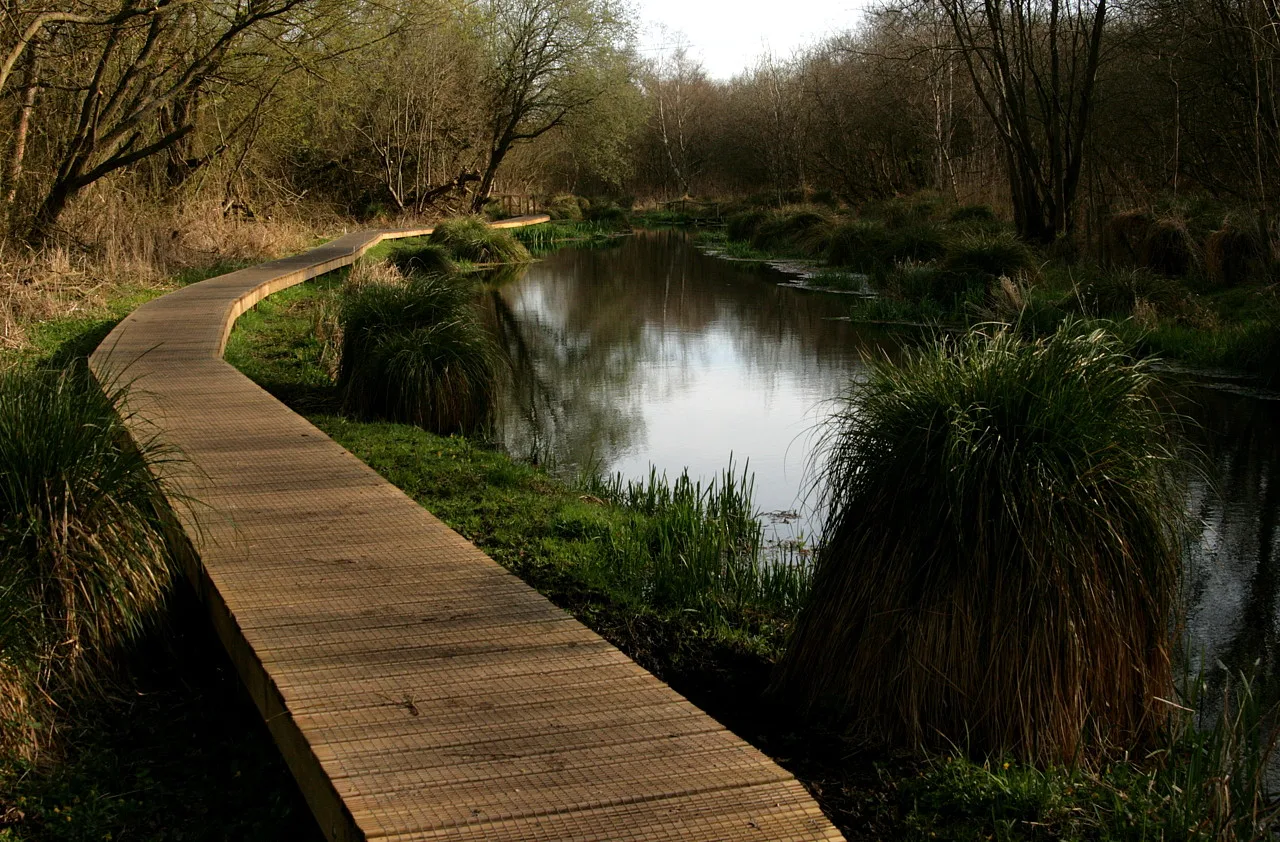
At the centre of it is the pumping station at Greywell, about two miles west of Odiham. The Environment Agency has refused to renew South East Water’s licence to take water there, because of the damage the pumping does to Greywell Fen. Hart’s note says South East Water is appealing.
Why Greywell matters
South East Water draws water for public supply from two wells and two boreholes in the chalk at its Greywell Pumping Station. The licence allowed up to 6,819 cubic metres a day, almost 6.8 million litres, and nearly 2.5 million cubic metres a year.
The Environment Agency published its refusal on 3 June 2026. Its decision statement sets out a long history:
- the pumping was expected to stop in 2020, because of its impact on Greywell Fen Site of Special Scientific Interest
- replacement supplies were not ready, so the licence was extended to March 2023
- in 2023 the company said the replacement infrastructure was in place, and the licence was renewed to March 2025, “for when abstraction would finally cease”
- in March 2025 the company applied again, this time until 2031
The company gave three reasons for needing Greywell. Nitrate in groundwater had cut supply at its West Ham and Cookham treatment works. Its licence at Lasham had been reduced. And the Surrey Hills to Greywell water main had been delayed. Its own options appraisal showed “an existing and worsening water supply versus water demand shortfall, especially under drought conditions”. (Environment Agency, decision statement NPS/WR/043914)
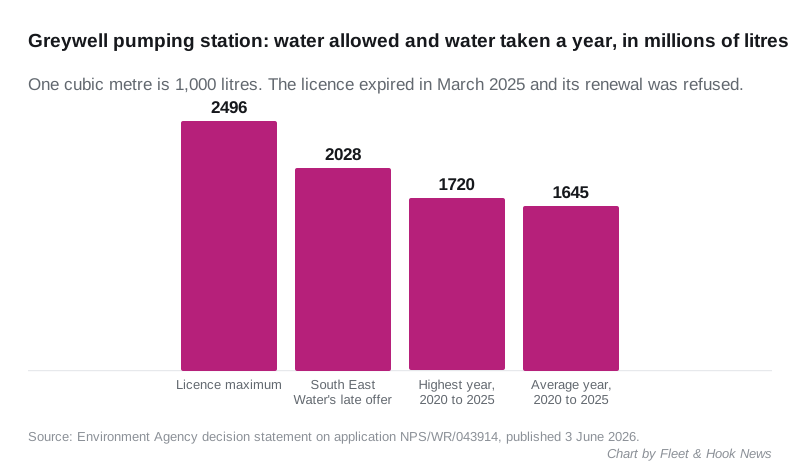
In the five years to 2024/25 the station’s busiest year took 1,719,761 cubic metres, and the average was 1,645,055. Late in the process, South East Water offered to cut the licence to 6,000 cubic metres a day and 2,028,000 a year. The agency refused anyway.
What the agency found at the fen
The agency says the pumping is “directly linked” to the failure of the Basingstoke Chalk groundwater body to reach good status. It found evidence of species loss and extinction at Greywell Fen.
Natural England agreed. It called the site “one of the largest remaining examples of alkaline fen in Southern England”. Both bodies concluded that the fen cannot reach favourable condition under any continued pumping, “even if reduced”.
The agency also noted that South East Water never handed over the findings of its own Greywell Fen investigation, “though requested a number of times”.
The decision statement says pumping under the expired licence stops at the end of the appeal period. Neither document says whether Greywell is still pumping while the appeal is heard.
What Hart’s planners advise
Hart’s note says South East Water has identified “potential water supply capacity constraints” in its zone known as WRZ4-W. That zone covers the western side of Hart and parts of East Hampshire and Basingstoke and Deane.
The note says Basingstoke and Deane first raised the issue after its own Local Plan consultation in March 2026. Since May 2026, the three most affected councils have run a joint steering group and taken advice from a senior barrister.
The Environment Agency has told the councils that the water used by any single development is “proportionally very small” against demand across the zone. It is therefore unlikely to object to planning applications on water grounds. But it says the security of supply is a separate worry, and that securing supplies is South East Water’s job.
Hart’s officers conclude:
- there is “no cogent and compelling case” for refusing applications on water resource grounds
- water supply should be given “limited weight” in planning decisions for now
- fixing the long-term problem will need strategic supply schemes, higher water efficiency standards and less leakage
- the new Local Plan will be backed by a water cycle study
The big schemes it covers
Officers will make sure water is addressed in reports on every scheme of 150 homes or more in the zone. They name three current applications:
- Murrell Green, up to 2,160 homes
- Owen’s Farm, Hook, up to 415 homes
- Lodge Farm, North Warnborough, about 100,000 square metres of business space
The Environment Agency had already flagged the zone on the Owen’s Farm application in August. It described it then as “currently experiencing a supply-demand deficit”.
What it means for you
- Neither the council’s note nor the agency’s decision says anything about supplies to homes being cut or restricted now. Both are about the long-term balance between supply and growth.
- If you are commenting on Murrell Green, Owen’s Farm or Lodge Farm, water supply will be weighed, but Hart’s advice is that it carries limited weight on its own.
- Hart’s Local Plan consultation, which sets where homes go up to 2039, closes on 7 December. Water supply is one of the things residents can comment on.
Sources
- Hart District Council, Water Resource Constraints briefing note, Development Management Committee, 18 November 2026
- Environment Agency, decision statement on South East Water’s Greywell licence, NPS/WR/043914
- GOV.UK, South East Water Limited: decision on licence application, 3 June 2026
- Hart District Council, committee agenda, 18 November 2026
Have your say