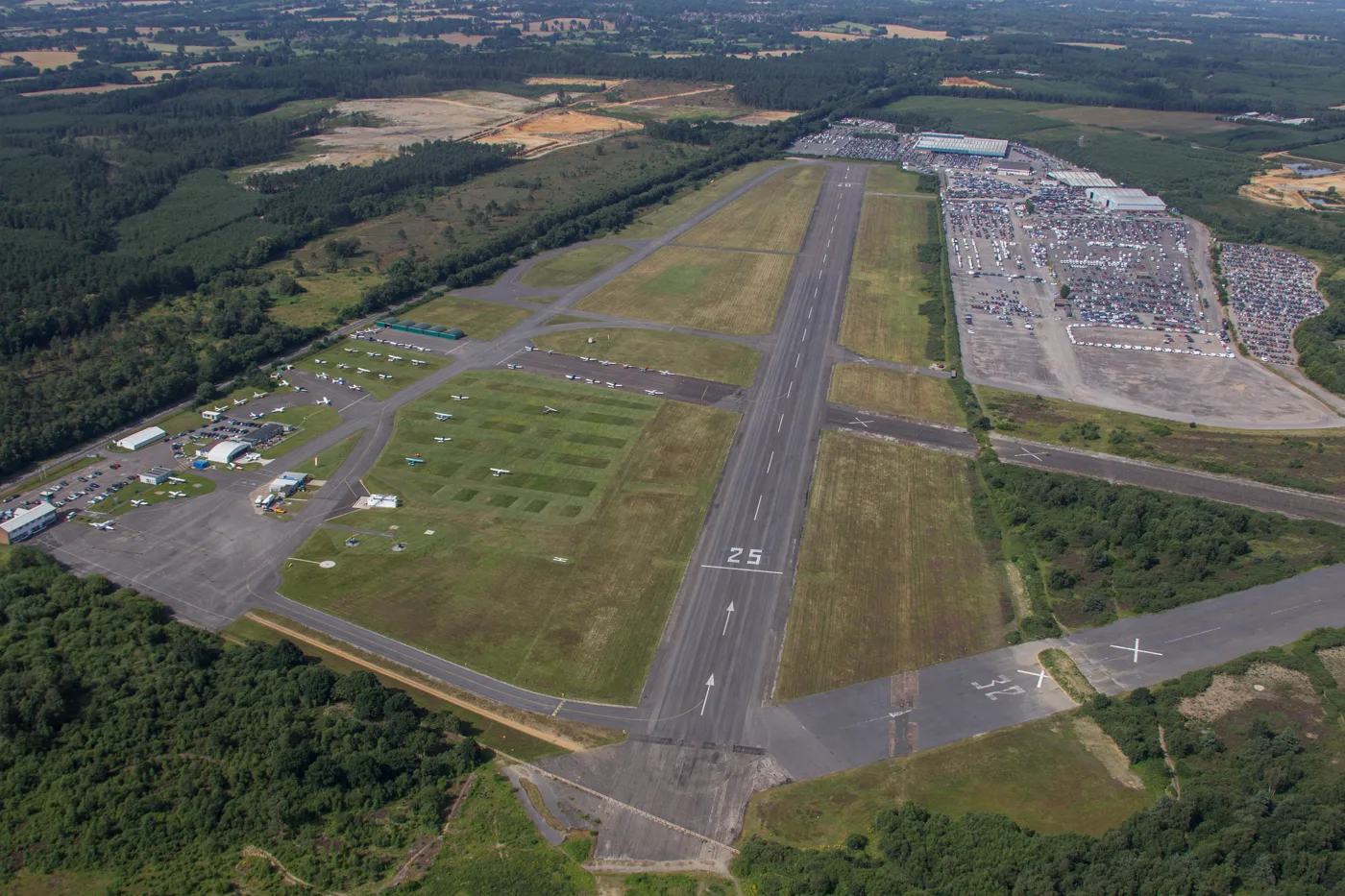

Blackbushe Airport wants two more hangars, 7,598 sq m, so visiting jets can stay overnight. Phase 1's four hangars open this autumn. What the register shows.
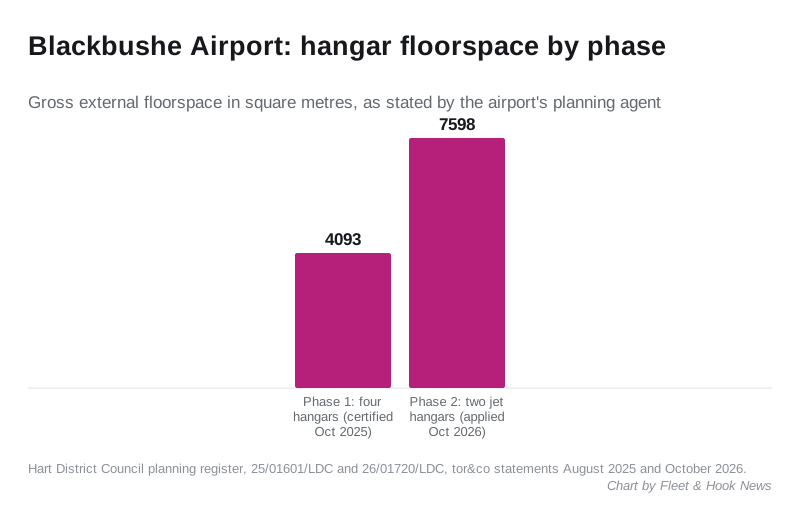
Blackbushe Airport has asked Hart District Council to confirm it can build two large hangars for business jets without planning permission. The two buildings would total 7,598 square metres, almost twice the floorspace of the four hangars now going up at the western end of the airfield.
The application, reference 26/01720/LDC, was received on 6 October and validated on 9 October. It appears on Hart’s planning register as “Erection of two aviation hangars and associated infrastructure”. A separate request for an environmental screening opinion, reference 26/01727/EIA, was validated two days earlier.
Blackbushe is on the A30 between Hartley Wintney and Blackwater, on Yateley Common, about three miles north of Fleet.
What is proposed
The two hangars, labelled Q and R on the drawings, would sit side by side south of the main runway, towards the centre of the airfield. They would stand immediately east of the four phase 1 hangars, which the plans label S, T, U and V.
The airport’s planning agent, tor&co, sets out the scheme in its statement:
- 5,068 square metres of aircraft floorspace inside the two hangars
- 2,190 square metres of aviation support space, on three floors at the ends of each building
- a landside car park to the south, linked to the existing access road
- an aircraft apron to the north, airside
- a site area of 1.92 hectares
The cover letter puts the gross external floorspace at 7,598 square metres and the application fee at £21,534.
The elevations show steel-framed sheds clad in black grey insulated metal panels, with anthracite roofs and dark copper metallic feature cladding at the ends. The hangar doors face north, onto the apron.
Why the airport says it needs them
The hangars are for jets that already use Blackbushe. The statement says the airport’s jet clients do not keep aircraft there overnight because there is no enclosed hangar space or jet-specific maintenance.
Instead, a jet flies in from another airport to collect its passengers, then flies back out after the return trip. The airport says that adds two aircraft movements to every return flight. Housing the jets on site “may, in fact, reduce the number of aircraft movements”.
The screening letter says Blackbushe handles between 35,000 and 45,000 flight movements a year, across commercial and private aircraft. The airport covers about 47 hectares.
The hangars would be fully insulated, heated by air source heat pumps or infrared panels, with solar panels on the roof.
Permitted development, not a planning application
This is not a planning application in the usual sense. Blackbushe is a statutory undertaker, and the airport says the hangars are permitted development under Class F of Part 8 of the General Permitted Development Order. That class allows an airport operator to put up operational buildings on its operational land, provided they are not a runway or a passenger terminal.
What the airport has applied for is a Certificate of Lawfulness of Proposed Use or Development. Hart’s job is to decide whether the law is being read correctly, not whether the hangars are a good idea.
When the council certified phase 1 last year, its officer report spelled that out: “Planning considerations and policies are not usually relevant in this context.”
The one hurdle is environmental assessment. Because the site is over one hectare, the airport has asked Hart for a formal screening opinion. Its own view is that two hangars at an existing airfield “does not have the potential to generate significant environmental effects”. If Hart agrees, as it did on phase 1 in October 2025, the permitted development route stays open.
The Environment Agency was the first consultee to respond, on 9 October. It said it did not need to be consulted at all: “We have no comments to make.”
What the screening letter says about neighbours
The agent’s letter addresses the usual concerns:
- Noise. The nearest homes are the Minley Road travellers’ site, about a kilometre to the south east, and properties at Little Vigo, about 950 metres north. Existing controls on operating hours, aircraft types and ground running stay in place. Most jet maintenance would happen inside the hangars.
- Traffic. A temporary rise in lorries during construction, then no significant change, because jet passengers already drive to the airport. No changes to the A30 entrance.
- Ecology. The site is mown grassland and taxiway. Part of it is a Site of Importance for Nature Conservation. The Castle Bottom to Yateley and Hawley Common SSSI, part of the Thames Basin Heaths Special Protection Area, lies beyond the airport’s northern and eastern boundaries. The airport says it would be unaffected.
- Flooding. Flood zone 1. Surface water from hardstanding would pass through oil interceptors to soakaways.
- Views from the A30. The hangars would be visible to drivers. The airport proposes infill tree planting along the southern boundary to screen them.
These are the applicant’s claims. Hart’s screening decision will say whether it accepts them.
Phase 1 is nearly built
The four phase 1 hangars were certified lawful on 15 October 2025, under reference 25/01601/LDC. They total 4,093 square metres and are for the airport’s resident light aircraft, which until now have mostly been parked outside on the grass.
The airport’s own news page charts the build. Groundworks for a new taxiway started in November 2025. Steel erection began on 23 June this year, with two cranes working weekdays from 7.30am to 3pm. The airport said the first hangar bay should be ready in late October, with the rest following through to December and landscaping into January.
In July the airport unveiled a new visual identity and said the copper cladding of the new hangars would become “a defining feature of the airport later this year”.
The common land deal behind it all
None of this was possible until last year. For six decades the operational airfield was registered common land, part of Yateley Common.
On 14 May 2025 the Planning Inspectorate decided in the airport’s favour on application COM/3336312, allowing about 35.3 acres of the aerodrome to be deregistered in exchange for 35.3 acres at Cottage Farm, Yateley, which is to be opened up and joined to the surrounding common. The airport said the decision “brings an end to six decades of uncertainty regarding its future” and promised a first phase of hangars within 12 months under permitted development rights.
It met that promise with phase 1. Phase 2 is the next step. The statement also confirms a “long-term vision for wider improvements and modernisation at Blackbushe (passenger facilities)”, to come forward through a full planning application “in due course”. That is the one that would get a proper public hearing.
What it means for you
- You can comment. Hart’s register lists both applications as open for comments. The council can only consider whether the development is lawful, so objections on noise or traffic grounds will not count against a certificate. 26/01720/LDC and 26/01727/EIA.
- When to expect a decision. Certificates run on the standard eight-week clock, so a decision is due by 4 December. Phase 1 was decided inside eight weeks.
- Flights. The airport’s case is that overnight hangarage cuts the number of jet movements rather than adding to them. The screening letter gives no numbers for how many jets would be based there.
- Construction traffic. Expect lorries on the A30 entrance during the build, as with phase 1.
Our planning page tracks the larger applications across Hart.
Have your say